
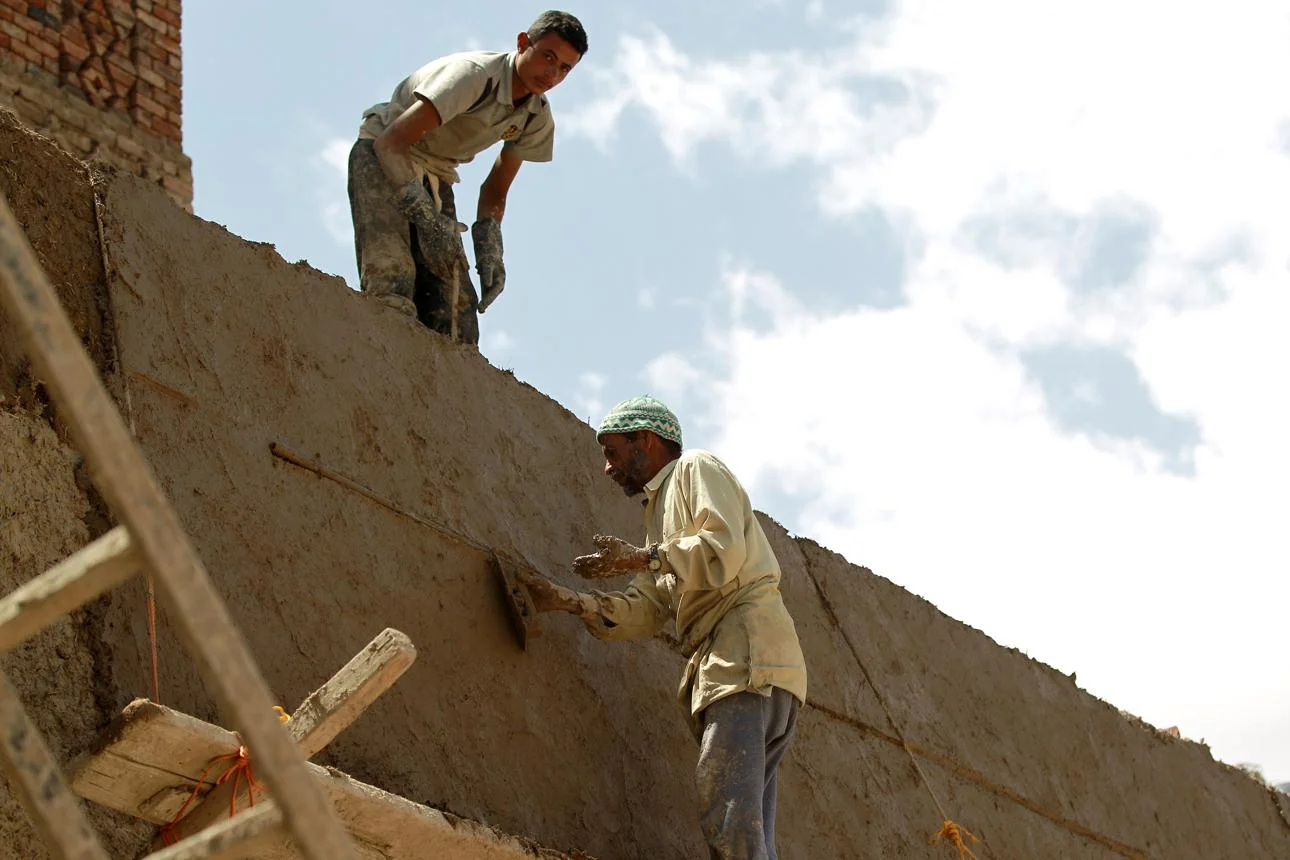
The authenticity of Sana’ani architecture is rooted in traditional materials refined through centuries of local building knowledge. Rammed earth and mud brick form key wall sections, burnt brick (yajur) defines upper elevations and façades, stone anchors lower foundations, and white gypsum (juss) highlights decorative bands and window surrounds.
When restoring a historic building, choosing a material simply because it is strong or readily available is not enough; it must be fully compatible with the existing fabric in terms of physical properties and structural behavior. Introducing an unsuitable cementitious mortar, for example, alters the wall’s moisture permeability and invariably triggers deterioration in adjacent historic materials.
Key guidelines include:
- Analyzing and identifying original materials before commencing work.
- Engaging master craftsmen experienced in traditional construction techniques.
- Testing repair mixes on a small, discreet test patch prior to broader application.
- Avoiding the removal of sound historic fabric simply due to surface weathering or color variation.
Specialized international charters for historic conservation emphasize rigorous planning, careful material selection, and rigorous quality control during execution. The optimal material is not necessarily the newest or the strongest, but the one most compatible with the historic building and its functional needs.